

How to Choose Compatible Keg Couplers Without Guesswork
Last Updated: November 2, 2026
Quick Summary
To choose compatible keg couplers, identify your keg's coupler system first, because D, S, A, G, U and M types look similar but do not fit each other. Check the head shape, lug pattern, probe arrangement and port positions against the keg valve. Confirm the system before ordering, and use an adapter only when no matching coupler exists.
- Identify the coupler system before buying, since brand alone is never a safe compatibility test.
- Compare head shape, lug pattern, probe arrangement and port positions to tell similar couplers apart.
- Hold the coupler against a clean valve in good light and never force a mismatched handle.
- Check gas and beer line connections and dip tube length, not just the coupler head.
- Use an adapter only where no matching coupler exists, since it adds another connection point.
Table of Contents
- What a Keg Coupler Does and Why Fit Matters
- Keg Coupler Types: D, S, A, G, U and M Explained
- How to Identify a Keg Fitting When the Label Is Missing
- Checking Keg Coupler Compatibility Beyond the Head
- When You Need a Keg Coupler Adapter and When You Don't
- Choosing Your Coupler: Buy the Micro Matic Sankey Coupler or Check Your Keg First
- Frequently Asked Questions
What a Keg Coupler Does and Why Fit Matters
A keg coupler is the fitting that connects your gas and beer lines to a keg. Get the fit wrong and the beer won't flow, or gas leaks out.
The coupler does two jobs at once. It seals onto the keg valve so gas can push the beer out, and it carries the beer line away. Because the seal has to be tight, the match between coupler and valve matters far more than it looks.
Watch out: buying a coupler that looks right is not the same as buying one that fits. Two couplers can look almost identical and still be incompatible.
Keg Coupler Types: D, S, A, G, U and M Explained
Keg couplers are not interchangeable, and the named systems below are the ones you will meet most often on UK draught equipment. Each has its own valve geometry, probe arrangement and locking method, so a coupler that seats on one keg will often refuse to seat on another.
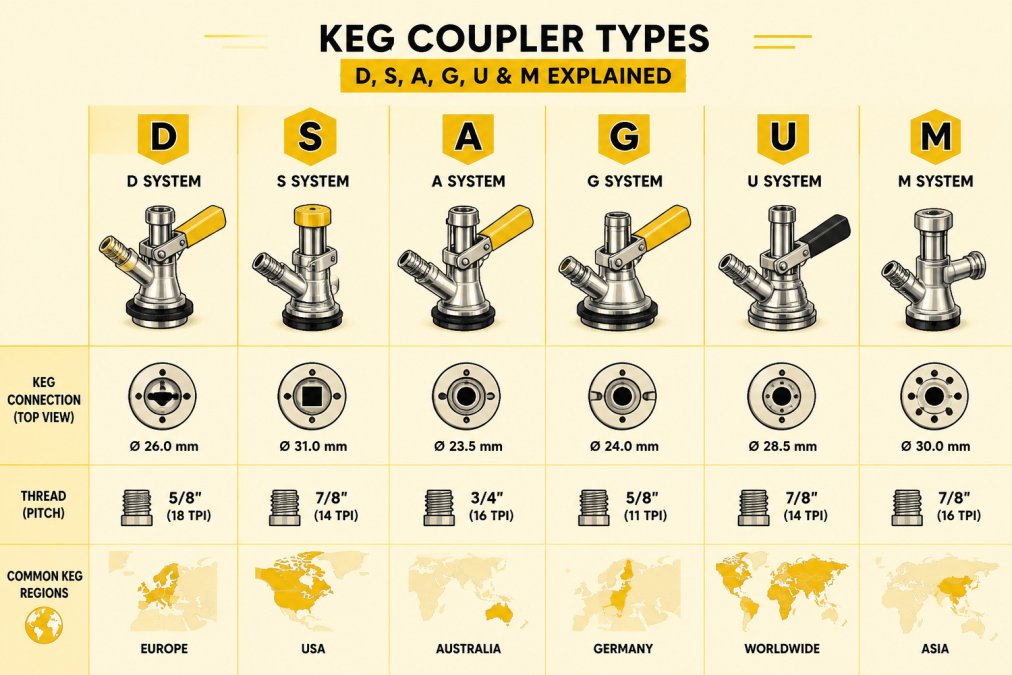
- D system: A two-probe, bayonet-style coupler with a distinctive slotted head. It is common on many European lager and ale kegs and is frequently found on imported brands. The D coupler typically has a wider body and a different lug pattern from the S type, which is why the two are so often confused.
- S system: The Sankey-style coupler, widely used on standard draught kegs in the UK and Ireland. It uses a single probe with a concentric gas and beer path and a characteristic lug arrangement on the valve. Most domestic brewery kegs and many large-brand lagers use this format.
- A system: A flat-top coupler with a different probe length and lug spacing. It appears on older or specialist equipment and on some imported kegs. Because it looks similar to the S type at a glance, check the lug pattern before assuming compatibility.
- G system: The Grundy-style coupler, used on certain brand kegs and some older cellar setups. It has a distinctive head shape and a different locking collar. Grundy kegs are less common than Sankey but still appear in UK cellars, particularly with legacy equipment.
- U system: The U-type coupler has its own valve and head shape, with a different probe and lug configuration again. It is less common than D or S but turns up on specific imported and specialist kegs.
A useful rule of thumb: the letter refers to the coupler system, not the brewery. That is why brand alone is never a safe compatibility test.
Telling Similar-Looking Couplers Apart
Many couplers look alike from a distance, and the D and S types in particular are routinely mistaken for one another. The clearest way to tell them apart is to check four features together:
- Head shape: Note whether the top is flat, domed or slotted, and whether the body is wide or narrow.
- Lug or notch pattern: Count the lugs and note their spacing and position. The pattern is the single most reliable visual clue.
- Probe arrangement: Check whether the coupler has one probe or two, and how the gas and beer paths are arranged.
- Port positions: Note where the gas and beer ports sit on the body and what thread or hose barb they use.
Hold the coupler against a clean keg valve in good light before you commit. If the lugs do not line up cleanly, stop, do not force the handle. Forcing a coupler is the fastest way to damage both the valve and the coupler head.
Matching Coupler Type to Brand and Keg
Brand lists are a starting point, not a guarantee. For a U-type fitting, see the Micro Matic U Type Keg Coupler. If your keg uses a Grundy fitting, the Micro Matic Grundy Keg Coupler is the matching option.
The table below summarises the main coupler systems and what each is typically used for, so you can narrow the options before checking your keg.
| System | Typical use | Key identifier |
|---|---|---|
| D | Many European lager and ale kegs, often imported | Wider body, different lug pattern from S |
| S (Sankey) | Standard UK and Irish draught kegs | Single probe, concentric gas and beer path |
| A | Older or specialist equipment, some imports | Flat top, different probe length and lug spacing |
| G (Grundy) | Certain brand kegs, legacy cellar setups | Distinctive head shape and locking collar |
| U | Specific imported and specialist kegs | Own valve and head shape, different probe and lugs |
| M | Niche and imported kegs | Valve geometry not compatible with D or S heads |
How to Identify a Keg Fitting When the Label Is Missing
Many people end up with a keg and no paperwork. In that case, you need to identify the fitting yourself. A practical workflow looks like this:
- Check any stamps, embossing or markings on the keg top and collar.
- Note the valve shape and count the notches.
- Compare the valve with a known coupler head.
- If you still can't decide, measure the valve diameter and note the valve height.
- Ask the supplier or brewer which system they use before ordering a coupler.
Using Valve Shape and Notches as Clues
Valve shape and notch pattern are the most useful clues. A round valve with a notch pattern on one side points to one system, while a different spacing points to another. Use these clues to narrow your options, then confirm with a physical test before buying.
Micro Matic Sankey Keg Coupler →
Checking Keg Coupler Compatibility Beyond the Head
The coupler head is only part of the system. Your gas line, beer line and regulator must also match the coupler's outlets. A coupler with the wrong thread or hose barb can leak even if the head seats perfectly.
Dip tube length also matters. For a cleaning bottle, check that the 5l Cleaning Bottle Dip Tube fits your bottle before you buy.
When You Need a Keg Coupler Adapter and When You Don't
An adapter lets you bridge two different coupler types. You need one when your keg and your coupler use different systems, but an adapter adds another connection point, so use one only when there is no matching coupler. Where a matching coupler exists, buy that instead.
Safety and Troubleshooting Checks Before You Connect
Before you connect, run through a short checklist:
- Confirm the coupler system matches the keg valve.
- Check the seal and O-rings for cracks or wear.
- Make sure the locking handle engages fully.
- Test the connection with gas before you open the beer line.
- Listen and feel for leaks at the connection.
If the coupler won't seat, do not force it. Forcing a coupler can damage the valve or the coupler head.
Choosing Your Coupler: Buy the Micro Matic Sankey Coupler or Check Your Keg First
If you know your keg is a standard Sankey type, the Micro Matic Sankey Keg Coupler is a sound choice at £36.00.

It is advisable to check your keg first, then buy. Work through the identification steps above, confirm the system, and only then add a coupler to your basket.
Shop the cellar at Keg Drop, where filtering by coupler helps you match kegs to the correct coupler from the start.
Frequently Asked Questions
How do I know which keg coupler fits my keg?
Start with the keg itself. Check the valve shape, the number and position of the notches around it, and any markings near the valve. Those features determine which coupler head will seat and lock. If the keg came from a supplier, their order confirmation or product page usually names the coupler system. When you are unsure, compare the valve against a known coupler head before buying, because similar-looking couplers are often not interchangeable. Keg Drop's coupler filtering on the product pages is designed to narrow the match for you.
Are keg couplers universal?
No. Keg couplers are not universal. The main systems, including D, S, A, G, U and M, use different valve connections and locking designs, so a coupler built for one system will not reliably seal on another. Some couplers look close enough to tempt a forced fit, but a leaking or badly seated coupler wastes gas, lets beer go flat and can cause a safety problem. Always match the coupler to the keg system and check the compatibility details before you connect.
Can I use a keg coupler adapter to make a different coupler fit?
Sometimes, but only with a purpose-made adapter that is rated for the specific keg and coupler combination. An adapter changes the connection, so it must seal correctly, lock securely and handle the working pressure of your system. Do not improvise with fittings that were not designed for this job. If the keg and coupler do not match, the simplest and safest route is usually to buy the correct coupler, such as the Micro Matic Sankey Keg Coupler at £36.00 for Sankey-type kegs.
What should I check before connecting a keg coupler?
Confirm the coupler system matches the keg valve, check that the locking handle engages fully, and inspect the seal and gas and beer connections for damage or debris. Make sure your gas regulator and beer line are rated for the pressure you plan to use. Connect gently, listen and feel for a secure lock, and check for hissing or leaks before you open the gas fully. If anything feels forced, stop and recheck the match rather than pushing harder.
