

How to Properly Store Beer Kegs: A 2026 Guide
Last Updated: October 24, 2026
Quick Summary
To properly store beer kegs, keep them upright in a cool, dark, stable space between 11°C and 13°C for most ales, slightly cooler for lagers. Steady temperature matters more than the exact number, so avoid warm-cold swings, light exposure and physical damage. Untapped kegs stay fresh for weeks to months, while tapped kegs are best within days.
- Cold storage suits kegs kept beyond a few days; room temperature only suits kegs you will tap quickly.
- Lagers and pilsners store at 8°C to 11°C and serve at 6°C to 8°C.
- Store kegs upright and never stack more than two high without proper racking.
- A full 50L keg weighs well over 50kg, so lift with your legs and get help.
- Use first in, first out: date every keg on arrival and store new stock behind old.
Table of Contents
- Step 1: Set Up Your Storage Space for Beer Kegs
- Step 2: Hit the Ideal Beer Keg Storage Temperature
- Step 3: Handle and Position Kegs Safely
- Step 4: Maintain Carbonation and Pressure
- How Long Does a Keg Last? Tapped vs Untapped Beer Keg Shelf Life
- Step 5: Rotate Stock and Monitor Storage Conditions
- Frequently Asked Questions
Step 1: Set Up Your Storage Space for Beer Kegs
Getting storage right starts before the first keg arrives. A cool, dark, stable spot is what keeps beer fresh, and most storage problems trace back to a rushed setup. At Keg Drop, we supply kegs to pubs, bars and home bar owners, and the same principle holds everywhere: control the environment first, then worry about the beer.
Choosing Between Cold Storage and Room Temperature
Cold storage is the better option for anything you plan to keep beyond a few days. A cellar, a dedicated fridge or a temperature-controlled unit all work well. Room temperature storage only suits kegs you will tap quickly, and even then, a shaded, steady spot beats a warm corner.
Think about your space in practical terms:
- Cellar or cool room: best for long-term storage and trade stock
- Shelf cooler: keeps kegs chilled and ready to serve
- Garage or shed: only if it stays cool and out of direct sun
If you are setting up cold storage for kegs, a shelf cooler gives you a dedicated chilled space rather than relying on ambient conditions.
Protecting Kegs from Light and Physical Damage
Light exposure spoils beer faster than most people expect. Ultraviolet light breaks down hop compounds and creates that familiar skunky smell (pubmed.ncbi.nlm.nih.gov). Keep kegs in a dark storage area, or cover them if light gets in.
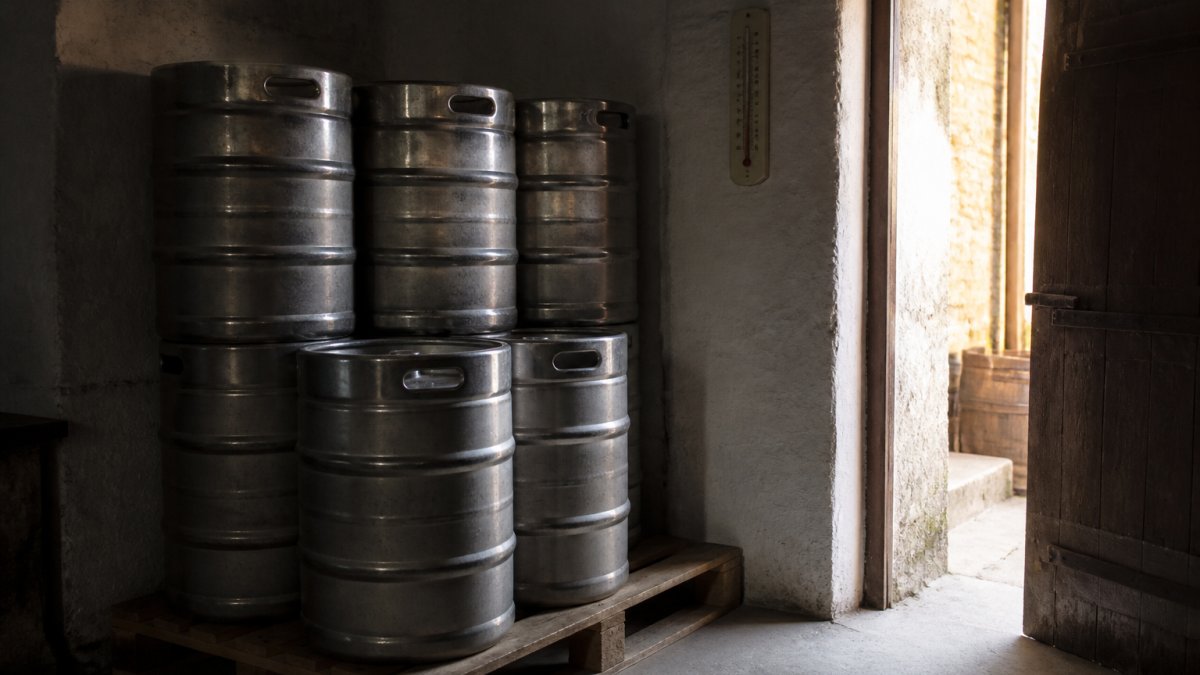
Physical damage matters too. Dented or scratched kegs can develop seal problems, and a damaged keg will not hold pressure properly. Stack them upright, keep them off bare concrete where possible, and leave space so you can move them without knocking them over.
Step 2: Hit the Ideal Beer Keg Storage Temperature
The ideal beer keg storage temperature sits between 11°C and 13°C for most ales, and slightly cooler for lagers.
Different styles tolerate storage differently, and the table below separates storage temperature from serving temperature so you can plan both.
| Beer Style | Storage Temperature | Serving Temperature | Notes |
|---|---|---|---|
| Lagers and pilsners | 8°C to 11°C | 6°C to 8°C | Store at the cooler end; avoid freezing |
| Ales and bitters | 11°C to 13°C | 8°C to 10°C | Classic cellar temperature suits cask and keg ales |
| Stouts and porters | 11°C to 13°C | 8°C to 10°C | Keep dark and stable; warmth flattens roast character |
| Strong and barrel-aged beers | 12°C to 14°C | 10°C to 12°C | More forgiving of warmth but still need consistency |
| Unpasteurised craft kegs | 4°C to 8°C | 6°C to 10°C | Cold storage slows decline; drink sooner |
Keg format matters too.
Temperature fluctuations are the real enemy. Every warm spell pushes carbon dioxide out of solution and speeds up oxidation.
Step 3: Handle and Position Kegs Safely
Kegs are heavy, and a full 50L keg weighs well over 50kg. Lift with your legs, keep the keg close to your body, and get help for anything you cannot move comfortably alone (Manual handling at work: Good handling technique).
Positioning rules that prevent problems:
- Store kegs upright so the spear and seal stay protected
- Never stack more than two high unless you have proper racking
- Keep the valve area clear so you can inspect it easily
Transport deserves its own caution. Secure kegs so they cannot roll, and let them settle for a few hours after delivery before tapping. A keg that has been shaken will pour foam until the beer settles again.
Step 4: Maintain Carbonation and Pressure
Carbonation is what makes kegged beer taste right, and pressure is what holds it there. An untapped keg keeps its own pressure through the seal. Once tapped, you take over that job with dispense gas and a regulator.
Twin Gas Bottle Holder With Gas Chain →
The basics of keeping pressure steady:
- Use the correct gas: carbon dioxide for most beers, mixed gas for longer lines or higher pressure setups
- Set the regulator to match the beer style and line length
- Check connections for leaks before and after every keg change
For maintaining keg pressure, a CO2 regulator gives you control over dispense gas. If you run mixed gas for carbonation and dispense, a mixed gas regulator does the same job for that setup. Getting the beer dispense gas right for your keg is the other half of the equation.


How Long Does a Keg Last? Tapped vs Untapped Beer Keg Shelf Life
An untapped keg lasts far longer than a tapped one.
The difference comes down to oxygen and pressure. An untapped keg keeps its own carbon dioxide blanket and a intact seal, so oxygen cannot get in.
How you store a tapped keg matters as much as how long you store it:
- Connected to gas and chilled: best case for a tapped keg; keep it under dispense pressure and it can hold for a couple of weeks
- Tapped but disconnected: the seal is broken and oxygen creeps in; drink within a few days
- Tapped and left warm: decline accelerates sharply; treat it as a short-term proposition only
Beer keg shelf life depends on four things: temperature, light, oxygen and how the keg is handled. Pasteurised kegs keep longer than unpasteurised craft beer, which is more sensitive to warmth and age. Homebrew kegs sit somewhere in between and reward careful handling. A keg that has been shaken in transit will also pour foam for a few hours, so let it settle before tapping.
Signs a keg is past its best:
- Flat or thin flavour with little carbonation
- A stale, papery or cardboard note from oxidation
- Cloudiness that was not there before
If you are planning stock for an event or a busy bar, it helps to browse the available kegs and match quantities to how fast you will pour them.
| Keg State | Typical Storage Window | Best Conditions |
|---|---|---|
| Untapped, pasteurised | Several weeks to a few months | Cool, dark, stable |
| Untapped, unpasteurised craft | Shorter, drink sooner | Cold, dark, minimal movement |
| Tapped, connected to gas | A few days to a couple of weeks | Chilled, pressurised, sealed |
| Tapped, disconnected | A few days | Chilled, drink soon |
| Homebrew | Varies, best kept cold | Cold, dark, well sealed |
Step 5: Rotate Stock and Monitor Storage Conditions
Rotation keeps old stock from sitting at the back while fresh kegs go out first. Use first in, first out as your rule.
Monitoring is the other half. A simple routine catches problems early:
- Check the cellar thermometer daily and log the reading
- Look for leaks at couplers and regulators weekly
- Inspect kegs for dents, rust or damaged seals on arrival
Power failures and heatwaves are the two events that undo good storage. Keep a plan for both: move kegs to the coolest available space, avoid opening the cold room door, and check pressure once conditions return to normal.
Frequently Asked Questions
Do beer kegs need to be refrigerated immediately?
Untapped beer kegs do not need refrigeration the moment they arrive, but moving them into cold storage as soon as possible protects freshness. If you cannot chill them straight away, keep them in a cool, dark, stable spot away from direct sunlight and heat sources. For the ideal beer keg storage temperature, aim for a consistent cellar range rather than a warm room. Once a keg is tapped, refrigeration becomes essential because the beer starts to oxidise and lose carbonation.
What is the ideal beer keg storage temperature?
Most ales and lagers store best between 11°C and 13°C for untapped kegs destined for a cellar, while tapped kegs should be kept colder, typically 3°C to 6°C, depending on the serve. The key is consistency: temperature fluctuations speed up staling and cause foam problems. Use a thermometer or data logger in your storage area and check it daily. For home bar setups, a dedicated fridge or a cool, shaded room works better than a warm kitchen or garage that swings with the weather.
How long does a keg last once it is tapped?
A tapped keg typically stays fresh for 3 to 5 days if kept cold and under steady gas pressure, though some beers hold up slightly longer. Untapped beer keg shelf life is much longer, often 3 to 6 months when stored cool and dark, depending on the style and whether the keg is pasteurised. Always check the date code on the keg and apply first in, first out rotation. If the beer pours flat or tastes stale, the keg has likely been open too long.
Should beer kegs be stored upright or on their side?
Store beer kegs upright whenever possible. Upright storage keeps the spear and valve at the top, reduces the risk of sediment disturbance, and makes it easier to check for leaks around the fittings. It also allows safe stacking on pallets without putting pressure on the keg body. If a keg must lie on its side during transport, return it upright and let it settle before tapping. Never roll or drop a keg, as rough handling can damage the valve and cause leaks.
Storing beer kegs well comes down to steady temperature, dark storage and careful pressure management. Get those right and every pour tastes the way it should. Keg Drop supplies 50L and 30L kegs with nationwide delivery and free collection from our depot, plus equipment compatibility filtering so your keg matches your coupler. Shop the cellar with Keg Drop and keep your stock fresh from delivery to the last pint.
