

Best 50L Kegs for Home Events: A Buyer's Guide
Table of Contents
- 30L vs 50L Keg: Which Size Suits Your Event
- Keg Coupler Compatibility: Matching the Keg to Your Tap
- Comparing the Best 50L Kegs Available at Keg Drop
- Home Keg Dispense Equipment: What You Need to Pour at Home
- Total Cost and Serving Yield for a 50L Keg at Home
- Order Your 50L Keg for Your Next Event
- Frequently Asked Questions
Last Updated: November 7, 2026
If you are planning a home event and want to pour your own beer, the 50L keg is usually the first size people consider. A standard 50 litre keg holds roughly 88 UK pints, which is enough for a sizeable gathering when you plan the numbers properly. This guide from Keg Drop explains how to calculate yield, match the keg to your guest list, and choose the right equipment for a 50L keg at home.
The honest answer is that a keg rarely pours a full 88 pints in practice. Foam, spillage, and the way guests fill glasses all reduce the yield. The numbers below assume a typical pour and leave a sensible margin.
Here is a simple way to estimate your servings:
| Guests | Pints Needed (approx.) | Suitable Keg |
|---|---|---|
| Up to 20 | 40-50 | 50L keg, or a 30L keg for a smaller event |
| 20-40 | 60-80 | One 50L keg |
| 40+ | 90+ | Two 50L kegs, or a 50L keg plus a second lighter brew |
30L vs 50L Keg: Which Size Suits Your Event
A 50L keg suits events with 25 or more guests, while a 30L keg is easier to manage for smaller gatherings. The bigger keg gives you more beer per changeover, but it is heavier to move and needs a larger cooling space. Many hosts find that one 50L keg covers a full evening, whereas two 30L kegs give more variety of beer.
Think about how you will move and store the keg before you commit. If you only have one fridge or cool space, a smaller keg may be the more practical choice.
Keg Coupler Compatibility: Matching the Keg to Your Tap
Not every keg fits every tap. The coupler is the fitting that connects your dispense equipment to the keg, and the wrong type will not seal. Several of the kegs in our range, including the Manchester Craft Lager and Original Lager from J.W Lees, use an A-type coupler, which is not included with the keg. Check your equipment before you order.
Our catalogue lets you filter by coupler so you can confirm compatibility before you buy.
Comparing the Best 50L Kegs Available at Keg Drop
Our current range covers a wide spread of styles, from crisp pilsners to richer lagers. Prices below are the starting prices listed on our site.
| Keg | Style | ABV | Starting Price |
|---|---|---|---|
| Seven Bro7hers Pilsner | Craft pilsner with Hallertau Blanc | 5.0% | £170.00 |
| Manchester Craft Lager | Lager, longer maturation | 4.7% | £160.00 |
| Original Lager | Crisp, light lager | 4.0% | £135.00 |
| Brooklyn Pilsner | Pilsner | 4.6% | £201.58 |
| Bangla Premium Beer | Golden premium beer | 4.3% | £132.40 |
| Fullers Frontier Lager | Hop-forward lager | 4.5% | £162.12 |
| Hofmeister Helles | Bavarian helles | 5.0% | £182.40 |
| Pardal | Sessionable lager | 3.8% | £126.48 |
| Veltins | German pilsener | 4.8% | £145.08 |
Starting Price
Seven Bro7hers Pilsner: Craft Lager with Hallertau Blanc
This is a clean, refreshing lager with floral, spicy and herbal notes. The Hallertau Blanc hops add a modern twist to a classic pilsner. At £170.00 it sits at the upper end of our 50L range, so it suits a host who wants a distinctive beer for a special occasion. You can order the Seven Bro7hers Pilsner 50L keg directly from its product page.

Manchester Craft Lager and Original Lager from J.W Lees
These two lagers come from the same brewer but differ in character. The Manchester Craft Lager is brewed in small batches with longer maturation, giving it more flavour. The Original Lager is simpler and lighter, with British malts and Styrian and Saaz hops. Both need an A-type coupler. If you are comparing the two, you can order the Manchester Craft Lager keg or order the Original Lager keg straight away.


Brooklyn, Bangla, Fuller's Frontier, Hofmeister, Pardal and Veltins
These kegs cover many styles. Brooklyn Pilsner offers a crisp, floral pilsner, while Bangla Premium Beer has a deep gold colour and was designed to suit spiced food. Fuller's Frontier Lager is hop-forward with a malty backbone. Hofmeister Helles is a classic Bavarian lager, Pardal is a lighter, sessionable option at 3.8% ABV, and Veltins is a German pilsener with a dry finish. Choose by the flavour you want and the drinking pattern of your guests.
Home Keg Dispense Equipment: What You Need to Pour at Home
Pouring a 50L keg at home generally requires a coupler that matches the keg, a tap or font to serve through, a gas or pump system to push the beer, and a way to keep the keg cold. Get any one of these wrong and you will either get a keg that will not connect, a glass of foam, or beer that goes flat and stale before the event is over.
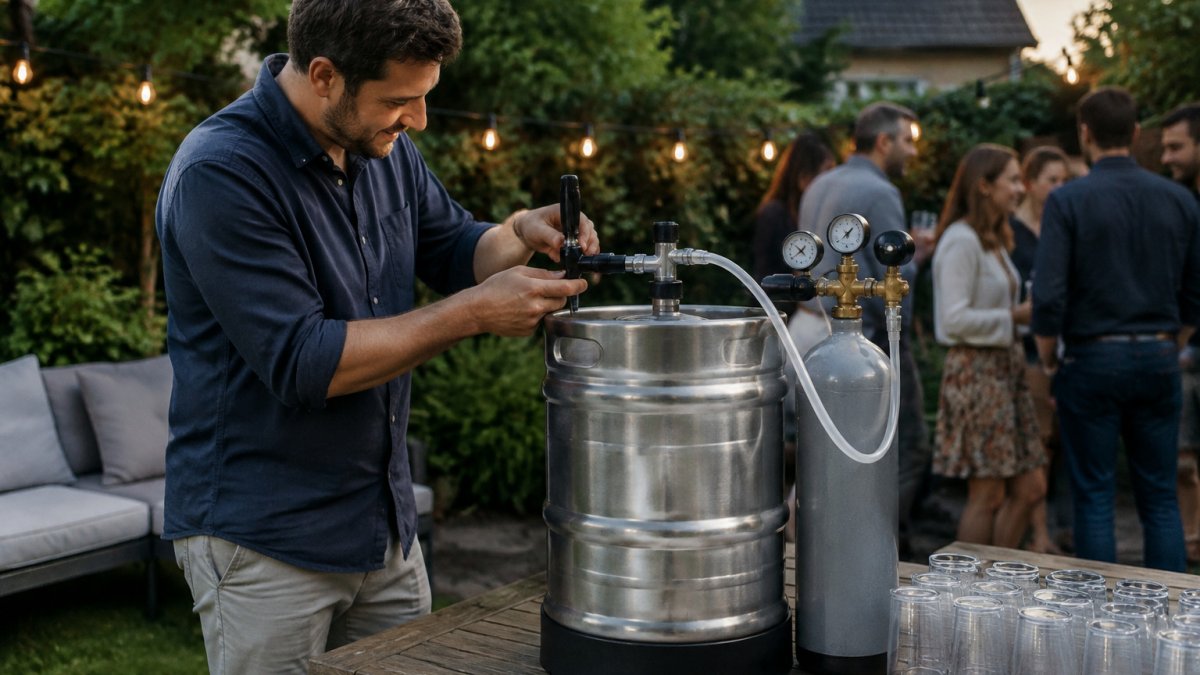
The coupler. This is the fitting that connects to the keg. Couplers are not universal, so check the coupler type on the product page before you order.
The tap or font. A basic picnic tap screws directly onto the coupler and is the cheapest way to serve. A proper font or bar-style tap gives a better pour and looks the part at an event, but it needs mounting and a line run to the keg. For a one-off home event, a picnic tap on a short line is often the most practical choice.
The gas or pump. Commercial kegs are pushed either by CO2 from a cylinder through a regulator, or by a hand pump that adds air. CO2 is the better option for anything longer than a single session because it keeps the beer in condition and lets you control pressure. A hand pump is simpler and cheaper but introduces air, which will flatten and spoil the beer within a day or so. If you use CO2, set the regulator low, most home setups serve comfortably at around 10-15 psi, and increase it only if the pour is too slow.
Cooling. Warm beer foams heavily and loses condition, so cooling is not optional. The main options are a dedicated keg fridge or kegerator, a converted chest freezer with a temperature controller, or a large bin packed with ice and a little water. Ice-and-water baths work well for a single evening but need topping up, and a 50L keg is heavy enough that you should build the cooling setup around the keg's final position rather than moving it once it is cold.
The line and connections. Keep beer line as short as practical, and check every connection for tightness before you tap the keg. A small leak at the coupler will waste gas and beer and is easy to miss once the event starts.
Watch out: tapping a warm keg and then trying to chill it will give you foam for the first hour and flat beer later, chill the keg fully before you connect it.
If you would rather not assemble the parts yourself, you can browse dispense pumps and machines to find equipment that matches your keg and coupler.
Total Cost and Serving Yield for a 50L Keg at Home
The keg price on the product page is the headline figure, but it is not the full cost of pouring 50 litres at home. A realistic budget has five parts: the keg itself, the coupler, the dispense equipment and gas, cooling, and any deposit or delivery charge. Most guides quote only the keg price, which is why hosts are often surprised by the final bill.
Keg. Our 50L range starts at £126.48 for Pardal and runs to £201.58 for Brooklyn Pilsner, with most lagers sitting between £135.00 and £182.40. That is the single largest line in the budget.
Coupler. If your keg needs an A-type coupler and you do not already own one, budget for it as a separate purchase. It is a one-off cost you keep for future kegs, so it is worth buying a decent one rather than the cheapest available.
Dispense equipment and gas. A picnic tap and a CO2 cylinder with regulator is the low-cost route; a dispense machine or kegerator is a larger outlay but removes most of the setup hassle. For a one-off event, hiring or borrowing equipment is often cheaper than buying, and it avoids storing kit you will not use again.
Cooling. A bin, ice and water is cheap but needs replenishing through the evening. A keg fridge or converted freezer costs more up front but pays back across multiple events and gives a more consistent pour.
Delivery. Delivery or collection can affect the total, so check both before you compare keg prices.
Realistic yield. A 50L keg holds roughly 88 UK pints, but no keg pours its full nominal capacity once foam, spillage and glass size are counted. Allowing for foam and spillage, plan for fewer pints than the nominal yield. If guests are drinking from larger glasses or the beer is served warm and foamy, plan towards the lower end.
Cost per pint. The keg price is only part of the cost. Add the coupler, gas, cooling and any equipment, and the true cost per pint rises.
Matching yield to the guest list. For a four-hour evening with 30 guests, assume most adults will have two to three pints, which is 60-90 pints and sits right at the limit of one 50L keg. For 40 or more guests, or a longer event, two kegs or a 50L keg plus a smaller back-up is the safer order. Running out mid-event is worse for the atmosphere than having a little left over.
Watch out: a keg that is not fully chilled before tapping will foam heavily, factor cooling time into your plan, not just cooling cost.
Order Your 50L Keg for Your Next Event
Choosing the right keg comes down to guest numbers, flavour, and your equipment. Match the keg to your coupler, plan around realistic yield, and order enough to cover the evening. You can shop the cellar to find a keg and coupler that fit your setup, with nationwide delivery or free collection from our Macclesfield depot.
Frequently Asked Questions
How many pints are in a 50L keg?
A 50L keg holds approximately 88 pints, based on the Original Lager Keg listing from Keg Drop, which states a volume of approx 88 pints (50 litres). Actual yield at a party is lower once you account for foam at the start of each pour, glass size, and any spillage.
Is a 50L keg suitable for a home party?
Yes, provided you have the right dispensing setup and the guest count justifies the volume. A 50L keg suits gatherings where many people will drink from a shared source over several hours, such as a birthday, wedding reception or garden party. For smaller gatherings, a 30L keg usually leaves less beer to go flat or waste. All the 50L kegs listed by Keg Drop are marked for home use, and each is sold without a coupler, so check which one your system needs before ordering.
Which coupler do I need for a 50L beer keg?
Several 50L kegs in the Keg Drop range, including the Manchester Craft Lager and Original Lager from J.W Lees, use an A-TYPE coupler, and the coupler is not included with the keg. Use the filter by coupler function on the Keg Drop site to match the keg to your dispense equipment before you buy. Mismatched couplers are the most common reason a new keg will not pour, so confirm the type with your tap or machine manufacturer.
What equipment do I need to serve a 50L keg at home?
You need a coupler matched to the keg, a CO2 supply with a regulator, beer line, and a tap or dispense unit. Many hosts use a portable keg kit or a tap set up on a table with the keg kept cold. Keg Drop stocks a range of dispense equipment and gas to pair with the kegs, including systems from PerfectDraft, BLADE and Brewlock. Allow time for the keg to settle after moving it before tapping, so the beer pours clearly.
